

Spoilers: The Odyssey, The Princess Diaries 2, Mamma-Mia.
Anne Hathaway is really having a good year, particularly in roles where she plays a queen: her blockbuster turn in The Odyssey, her upcoming reprise in The Princess Diaries 3,1 and Devil Wears Prada 2. And again, all I could think about was the institutional design of her respective kingdoms. Hathaway’s path as Queens of Ithaca and Genovia runs through two key questions about institutional design that all rulers have to answer, noble and democratic alike: how are leaders chosen, and how do they stay in power?
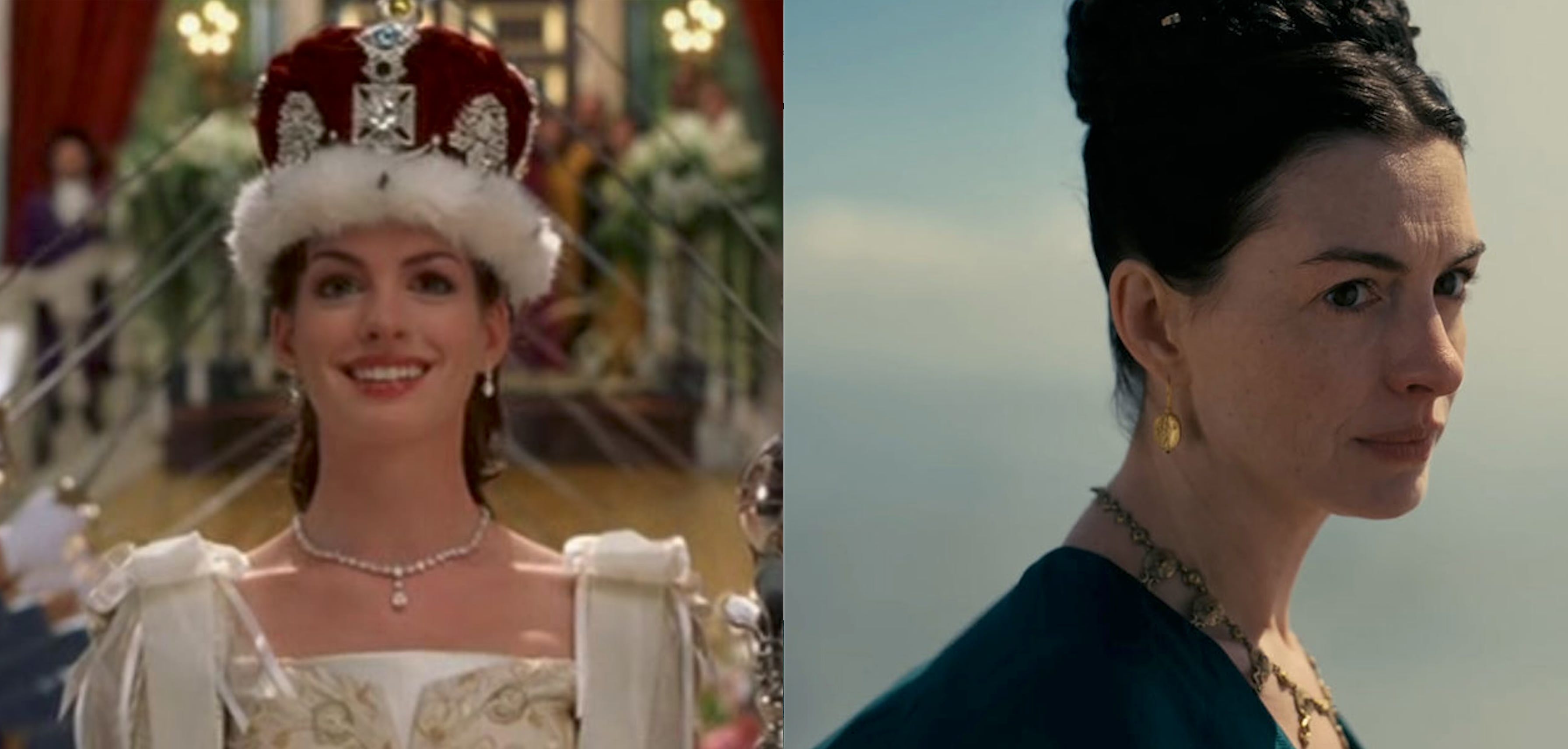
In Christopher Nolan’s The Odyssey, Anne Hathaway plays Queen Penelope of Ithaca, wife of King and protagonist Odysseus. After decades of Odysseus being away at war, presumed dead, Penelope faces increased pressure to let him go and marry a suitor. Unsurprisingly, all the men who are intrigued by that proposition are incredibly annoying. Her son, Prince Telemachus, is not yet ready to accept his father’s death and take his place. So, she faces the real possibility that her family and legacy may lose the throne for good.
Princess Mia of Genovia is in an almost identical situation. Genovian law requires a female heir to marry before she is eligible for the throne, so Mia sets out to find a husband. By the end she decides the whole affair is preposterous. She calls off her own wedding, lets Julie Andrews take her place at the altar,2 and strikes down the marital law to cement her control.
This jockeying is the exception that shows the rule: hereditary succession existed to make the handoff of power boring, and yet did the opposite.
Every country and every organization has to pass power from one person to the next in a way people will accept. Humans have tried almost every possible arrangement with varying degrees of success: seniority systems that value the presumed wisdom of the elders, religious ritual that lets the clergy decide whose claim God happens to favor, or elections.
In Ithaca and Genovia, leaders were chosen by birthright, known as primogeniture. When the lineage is established, and the heir of age, the succession is clear. This has a huge benefit to the leadership: control the familial marriages and you can avoid costly civil wars or crises that might arise from uncertainty. Even if they thought the heir was a complete moron, the institutions around the throne like the military and the clergy bought into this system because they knew everyone else did, and so no one is at risk of backing the wrong horse. A predictable idiot beats an uncertain genius every time.
Penelope's suitors and the Genovian Parliament are those institutions, and they broke in opposite directions. In Ithaca the bargain fell apart: without Odysseus there, the suitors stopped believing in the promise of primogeniture, and the fighting ensued. Genovia had the opposite problem. Mia was the closer heir, but Genovian law required a female heir to marry before she was eligible, and so Nicholas Devereaux was next in line. He had the weaker claim and the better standing. He lost anyway, because Queen Julie Andrews held enough sway with the institutional leaders, and Mia leveraged the relationships she made, through the common people or the Prime Minister, to make backing her claim the safe bet. Either way, the succession law itself was the source of the uncertainty it promised to remove. Mia stayed in power by changing the rule. Odysseus secured power by removing everyone who objected.
If the family relationship is contested, such as having a kid through an affair, or if there were simply no eligible heir to begin with, such as having only daughters, the arrangement breaks down. With no plan B, the throne goes to whoever can take it by force or by leverage. While the ending of the Odyssey kind of sidesteps this whole issue by just having Odysseus kill every “institution” contesting the throne, it nevertheless only proves the point: succession law is written very specifically by the powers that be, and it can be wrecked by something as innocuous as being a girl dad.
I watched Princess Diaries 1 and 2 recently, so this is my way of bringing it up.
Not unlike in Mamma-Mia
I find it interesting how a strict primogeniture society stacks up against a more democratic society - both can end up in leadership vacuums that cause civil wars and / or internal strife. But a primogeniture structure means that leadership always defaults to strength of personality first, hence why young Telemachus can’t keep control of Ithaca. What’s interesting to me about Nolan’s movie is that it sort of loses the fact that that’s the entire thrust of Telemachus’ arc in the text. Nolan’s Odysseus wants to leave his son unstained by war so he can be a “pure” heir. Homer’s Telemachus, on the other hand, isn’t ready to be the heir until he proves he’s able to destroy his opposition alongside his father.